
The academic curriculum for Grades 9 and 10 at The Francis de Sales Centre is a liberal arts program which introduces the students to the Greco-Roman roots of western civilization while strengthening their abilities to reason and to express themselves in speech and in writing. Students participate in physical education and arts programs offered throughout the city, in curriculum-based school trips, as well as extra-curricular clubs.
This course offers a comprehensive examination of Sacred Scriptures and their relation to the Catholic Church. Students learn about the Canon of Scripture, the Church’s role in interpreting them, biblical typology, and the dramatic events and themes which unfold in salvation history in both the Old and New Testaments. Students also learn to meditate on passages from the Gospels using the Church’s long tradition of Lectio Divina. An inspiring study of the lives of particular saints gives practical examples of how the Gospels can be put into action in service of God and neighbour.
This course offers an in-depth study of the Church’s tradition of Prayer, the Holy Mass, and the Sacraments, as well as an introduction to the study of Church History from its beginnings to the Edict of Milan. Readings include primary sources such as the Epistles of Clement and Ignatius, the Martyrdom of Polycarp, and the Didache.
This introductory course consists primarily of a thorough study of the oldest works of European literature, The Iliad and The Odyssey. Topics discussed include oral tradition and Greek religion, ritual, and fate, as well as ancient attitudes towards honour, justice, vengeance, and death. To round out the year on a lighter note, students also study Shakespeare’s Twelfth Night, focusing on the characteristics of comedy.
In this course students study Virgil’s Aeneid and Shakespeare’s Antony and Cleopatra, writings that bring up questions of fate, piety, good government, and the tensions between public duties and individual desires. In addition to these texts, students read three 20th-century novels: The Pearl by John Steinbeck, The Chrysalids by John Wyndham, and To Kill a Mockingbird by Harper Lee, which allow us to discuss and evaluate different treatments of and responses to the common theme of injustice.
Through the study of ancient literary works of history, the students are introduced to classical Greek history, the rise of the city-states of Athens and Sparta, and the formative Persian and Peloponnesian Wars. Throughout the course, discussion is focused on the development of influential ideas in the Greek world which continue to be an influence in our day and also on the similarities and differences between the classical Greek world view and the Christian one.
This course on the fundamental principles of physical science, including lab work, provides the foundation for the study of Biology, Chemistry and Physics throughout high school and beyond. Topics covered include an introduction to properties and states of matter, atomic structure, the periodic table, chemical bonds and reactions, solutions, acids and bases, forces and motion, forces in a fluid, work, power and machines, energy, thermal energy and heat, mechanical waves and sound, the electromagnetic spectrum and light, optics, electricity and magnetism.
This course is designed to give students an appreciation of creation and of the order and complexity of living things. Instruction is supplemented with regular lab work. Topics include the nature of life, ecology, cells, genetics, evolutionary theory, microorganisms and fungi, plants, invertebrates, chordates, and the human body. The science of biology presents student with some controversial issues, such as theories of evolution, stem cell research, genetic engineering, and cloning. It is a goal of this course to discuss these issues in light of Church teaching.
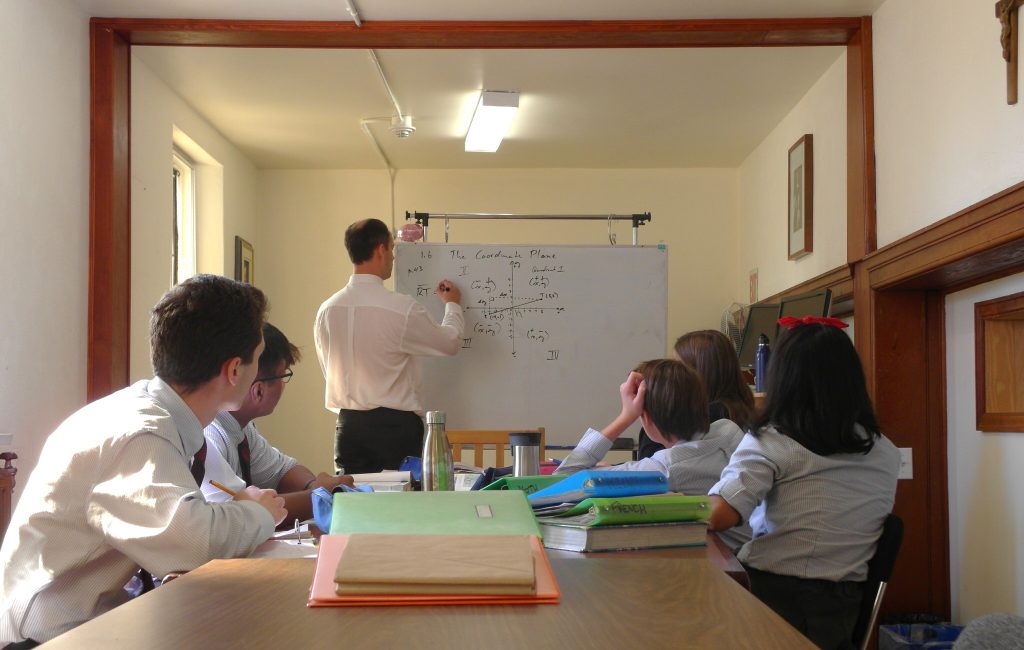
The course aims to provide students with analytical and reasoning skills, particularly the ability to express real life problems in the form of equations, and the use of mathematical techniques by which to solve them. Major topics include equations in 1 and 2 variables, simultaneous equations, exponents, polynomials, square roots, quadratic equations, and inequalities.
This course includes an introduction to sequences and series and to probability, as well as an introduction to the study of geometry, covering topics such as geometric reasoning and proofs, parallel and perpendicular lines, congruent triangles and relationships within triangles, quadrilaterals, area, similarity, right triangle trigonometry, surface area and volume, circles, and transformations.
Students work on developing a thorough command of regular and irregular verbs in the present, past, and imperative tenses. Concepts include reflexive verbs, the use of direct and indirect object pronouns, and irregular adjectives. Through the use of media students familiarize themselves with cultural elements from the French-speaking world.
Students learn the imperfect tense and how to use the imperfect and past tenses together when describing past events. They also learn the future tense of both regular and irregular verbs, as well as the conditional tense. They learn how to use direct and indirect object pronouns in a variety of sentences in the various tenses, including the imperative. They are exposed to French culture through French songs and short stories and through learning more about foods and menu items found in the French-speaking world.
This course focuses on developing students’ abilities to speak and write. Classes include vocabulary, speaking and writing components. Themes and exercises include impromptu persuasive argument, the construction of effective sentences, paragraphs, narratives and short essays, some creative writing, memorization and recitation of poetry, and the analysis of examples of excellence in rhetoric and writing from a variety of sources. The students have also participated in the national Poetry In Voice competition.
This course continues to focus on the development of students’ abilities to speak and to write effectively and persuasively. Students continue to study the basic structure and components of rhetoric following exercises based on classical rhetorical training. These exercises include the retelling of fables and poetry, impromptu persuasive argument, construction of effective sentences, paragraphs, narratives and short essays, memorization and recitation of poetry, and the study and presentation of examples of excellence in rhetoric and writing from a variety of historical and literary sources. The students have also participated in the national Poetry In Voice competition.
This course offers an intensive introduction to the study of classical Latin for students with little or no previous exposure. There are daily readings in Latin and Latin-to-English and English-to-Latin exercises, along with a structured presentation of Latin grammar, relating it to what the students know of English grammar. By the end of the course, the students have been introduced to five declensions of nouns and adjectives and the major tenses of the indicative mood, and are reading basic classical Latin texts.
This course continues from Latin I with an intensive introduction to the study of classical Latin. The year begins with daily readings in Latin and Latin-to-English and English-to-Latin exercises, along with a structured presentation of Latin grammar, relating it to what the students know of English grammar. By the end of the course, the students will be translating much longer passages of Latin, including some passages from Caesar’s Gallic War.
This elective course teaches students the rudiments of music theory. Topics covered include: Music Notation; Time Values; Accidentals; Scales (Major, Minor, Chromatic, Whole-Tone, Pentatonic, Blues, Octatonic); Modes; Intervals; Time (Simple, Compound, Hybrid); Note Grouping; Triplets; Terminology; Chords; Triads (Major, Minor, Augmented, Diminished; Inversions); Dominant 7th and Diminished 7th Chords; Cadences (Perfect, Plagal, Imperfect); Transposition.
This course takes students through three centuries of cultural development by focusing on the relationships between music and other cultural phenomena from 1600 to the outbreak of the First World War. The course materials include a set of lectures on DVD and a 3-CD collection of musical pieces the students will learn to identify through ongoing listening exercises. Topics covered include musical technology, the rise of the Baroque period, opera, the Enlightenment and Classicism, Romanticism, tone poems, nationalism, Modernism.
This elective course surveys the history of Western Art, with special focus on the arts of the Christian world as the heart of Western Civilization. Non-western art traditions will be introduced where they provide instructive context or comparison. Students will learn to identify and appreciate the evolution of styles, media, and cultural objectives across the spectrum of art in two and three dimensions: painting, sculpture, crafted objects, architecture, and their inter-relationship in sacred, domestic, or civic contexts.
The course is designed to give students an appreciation of the order and complexity of creation, and of the order and complexity in the cosmos. The course covers the different kinds of celestial objects, their characteristics, how they formed and developed, and their eventual fates. This includes a discussion of stars (including our sun), star groups, black holes, asteroids and comets, the earth, moon, and planets. It also covers the theories of the origin, development, and future of the universe, as well as whether other planets and life forms exist in space. The student will study, and have the opportunity to observe, the main stars and constellations for both summer and winter.
This elective course introduces students to the fundamentals of drafting, starting with the alphabet of lines and basic sketching. Students will learn the proper use of drafting equipment such as T-squares, set squares (triangles), and scales, and will learn how to construct basic geometric figures. Students will also be introduced to multiview and pictorial drawing, as well as the fundamentals of lettering.
It usually takes our son quite a bit of time to adapt to a new environment. We were impressed that my son felt at home even on his first day at Mary, Mother of God School.
Going to Mary, Mother of God School was more than just going to excellent classes. It was coming to a place where I felt loved.
Our family is truly blessed to have found Mary, Mother of God School. We have been able to watch as our children have grown in faith and knowledge through the careful direction and the tireless work of the staff.
We decided to send our two children to Mary, Mother of God School because we want them to receive the best truly Catholic education. Through the dedication of the teachers, my children are nurtured in a loving and respectful environment which strikes a balance between spiritual nourishment and academic excellence.
This school taught me to love studying. It taught me the importance of my Catholic Faith. And most of all, it taught me to love and care for others.
The Francis de Sales Centre has not only given me an education, but it has given me a code to live by for the rest of my life. It has taught me to serve the poor, the homeless, the dying the elderly, and the mentally ill.
At FSC there is a sense that the teachers are on your side. I valued learning about our faith in an in-depth way, which is a basis for knowing Christ and growing closer to him.
At FSC, I received an education, that, by exposing me to great works of literature and classical teachings, inspired me and helped me begin to understand what it means to be human. I was always excited to be in an environment of true learning, alongside classmates who became good and lasting friends.
The bonds I formed at FSC could not have been formed anywhere else. Not only do I have countless memories that can make me cry with laughter to this day, but the atmosphere at FSC offered a place where friendships could truly flourish.
Faith is the greatest gift we could give to our children. We are very happy to send our children to this school where faith formation is emphasized and the teachers strive to be examples of our Catholic faith.
| S | M | T | W | T | F | S |
|---|---|---|---|---|---|---|
| 1 | 2 | 3 | 4 | 5 | 6 | |
| 7 | 8 | 9 | 10 | 11 | 12 | 13 |
| 14 | 15 | 16 | 17 | 18 | 19 | 20 |
| 21 | 22 | 23 | 24 | 25 | 26 | 27 |
| 28 | 29 | 30 | ||||